2025 Election
Bill aimed at blocking DATCP’s ability to raise fees headed to Evers

Bill aimed at blocking DATCP’s ability to raise fees headed to Evers

(The Center Square) – A bill that will end the ability of the Department of Agriculture, Trade and Consumer Protection to raise fees for animal market licenses, animal dealer licenses, animal trucker licenses and animal transport vehicle registrations is now headed to Wisconsin Gov. Tony Evers.
Senate Bill 622 passed the Assembly with a 57-42 vote after the bill was passed 22-11 by the Senate a week earlier, both on partisan votes.
The bill came after DATCP had proposed increasing a livestock market fee from $420 to $7,430, trucker license fees from $60 to $370 and animal dealer fees from $220 to $670 last year before receiving significant pushback and later proposing smaller increases.
Those changes came after a Wisconsin Supreme Court ruling that blocked legislators from oversight on rulemaking with Evers telling agencies to bypass having rules heard in committee and instead simply enact them.
That leaves in question if Evers will sign or veto the bill.
The Wisconsin Farm Bureau and Americans for Prosperity–Wisconsin collected public feedback, sending it to DATCP after the rules were proposed.
DATCP said in a fiscal estimate that the bill would force the agency to operate with a negative cash balance unless the fees or a funding source are changed.
“This bill would remove DATCP’s ability to propose fee adjustments through the statutorily set administrative rulemaking process,” the fiscal estimate said. “Without revenue adjustments, the appropriation will operate in a negative cash balance until additional funding sources are identified.”
DATCP Secretary Randy Romanski said in testimony that the programs had a negative cash balance of $267,000 at the end of last fiscal year, which is expected to grow to more than $1.1 million by the end of this fiscal year and said that Evers’ last budget proposal asked for seven new full time positions while four were ultimately granted.

Evers highlights bipartisan work in his final Wisconsin State of the State

Evers highlights bipartisan work in his final Wisconsin State of the State

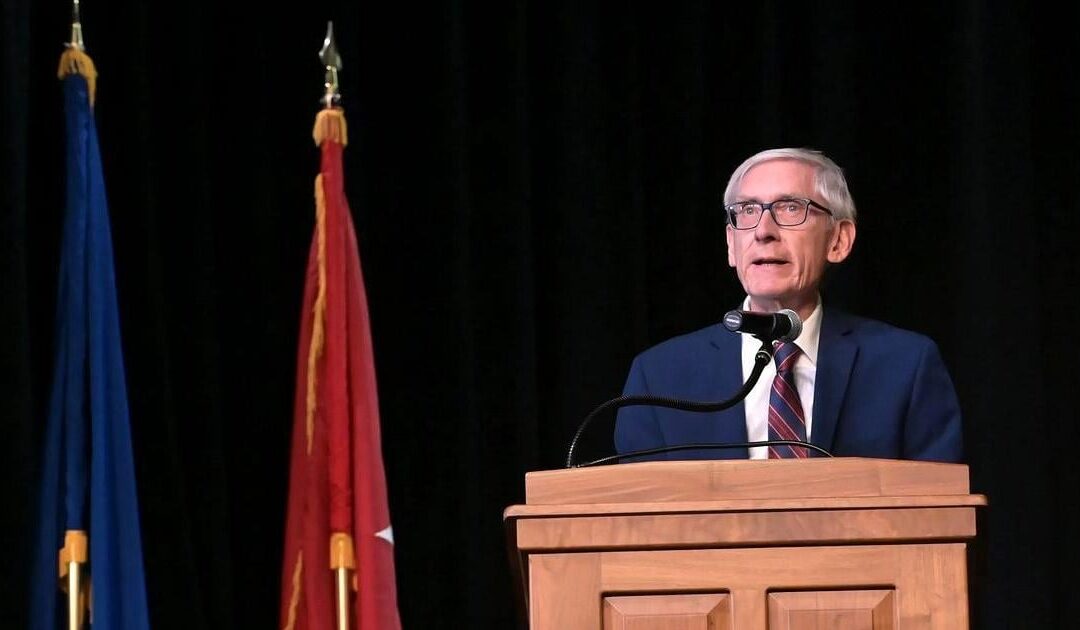
(The Center Square) – Wisconsin Gov. Tony Evers wants the public to concentrate on the bills and times that he had reached agreements with the Legislature as he is set to continue an interesting week of negotiations on a tax-cut proposal from legislative Republicans.
Evers announced he would call a special session this spring to ban partisan gerrymandering of legislative maps.
Earlier in his speech, Evers said that a plan for property tax relief and education spending must balance the two “a heck of a lot better” than the plan Republicans sent to him this week.
“I’m going to ask lawmakers to stick around until our work here is finished,” Evers said.
Tony Evers just said no to the Republican plan that puts this surplus back in your hands and addresses the ridiculous property tax increase he did via his veto plan. So much for bipartisanship.— Senator Julian Bradley (@SenBradley) February 18, 2026
“Tony Evers just said no to the Republican plan that puts this surplus back in your hands and addresses the ridiculous property tax increase he did via his veto plan,” Sen. Julian Bradley, R-New Berlin, wrote during the speech. “So much for bipartisanship.”
In his rebuttal to the State of the State, Senate Majority Leader Devin LeMahieu said that the state should not be sitting on $2.5 billion of projected surplus while Wisconsin families struggle to pay bills.
“We want to give that money back to you,” LeMahieu said.
Evers highlighted everything from justice system reform, adding circuit court branches, workers’ compensation for firefighters and law enforcement and paying down state debt.
“I’ve signed over 800 bills as governor, and more than 97% of the bills I’ve signed passed with bipartisan support,” Evers boasted in his State of the State speech.
He then pointed out that he is often criticized for his use of the veto, particularly when he used a partial veto and erased numbers and a hyphen to change “2024-25” to “2425” in the budget bill, locking in a $325 per student per year funding increase for 400 years.
Evers justified the action, saying he was using his veto pen to benefit kids.
He said that average wages went up 26% in the state in his first six years in office and that median income has reached an all-time high.
Evers announced that a new film tax credit and office would start this week.

Vos’ waiting for Evers to come to table on tax cut proposal

Vos’ waiting for Evers to come to table on tax cut proposal

(The Center Square) – Assembly Speaker Robin Vos believes that having a short timeline to discuss a tax cut bill before the end of the legislative session could be helpful in tax cut negotiations.
Vos said that a tax cut proposal sent to Gov. Tony Evers on Sunday would accomplish those goals with $1.5 billion in tax rebate checks, $200 million in additional special education funding and $500 million in a school tax levy credit.
Vos said that he hopes he can hear from Evers before session ends Friday.
“Deadlines are what make politicians act,” Vos said.
Early excerpts from Evers’ Tuesday night State of the State speech included references to that short timeline.
“I know many lawmakers are antsy to end the legislative session and pack up to get back on the campaign trail,” the excerpt said. “Folks, I know many of you are up for election, but here’s the deal: after years of delivering historic, bipartisan wins for our state, Wisconsinites have high expectations for the work we can do together over the next ten months – and they should. Just look at what we’ve accomplished over the last seven years.”
The tax cut proposal would spend down $2.3 billion of the $2.5 billion in estimated surplus for the state by the end of this budget.
“We’re overtaxed our citizens in Wisconsin,” Rep. Patrick Snyder, R-Weston, said about the surplus. “In doing that, we’re offering a $1,000 rebate to couples and $500 to individuals. In this time, with affordability and things of that nature really wearing on families, this at least is somewhat relief for what we overcharged them as a Legislature.”
Rep. Mark Born, R-Beaver Dam, said that the surplus allows the Legislature to return the majority of the surplus to taxpayers.
“It’s a great compromise,” Born said. “We heard the governor and what his priorities were, we worked on a package and it’s a real opportunity for us to build on what we have accomplished this session. And the governor should take the deal.”
Vos explained that it is better to have the education funding go to special education and school property tax credits rather than the general school fund because then it will be distributed more evenly across the state.
“Now we have two active participants, myself and Sen. LeMahieu, now we just need a third partner, which would be Gov. Evers, to want to come to the table,” Vos said.

Wisconsin Republican leaders offer new tax plan

Wisconsin Republican leaders offer new tax plan

(The Center Square) – There is a new tax relief offer at the Wisconsin Capitol.
The state’s two Republican leaders, Assembly Speaker Robin Vos and Senate Majority Leader Devin LeMahieu, on Monday sent a letter to Gov. Tony Evers with a new offer for both income tax and property tax relief.
“This is a generous, good-faith attempt to achieve our mutual goals of limiting the property tax impact caused by your misguided 400-year veto, helping families address rising costs, and ultimately doing what is best for the people of Wisconsin,” the two wrote.
The plan offers $500 in money for the state’s school tax levy credit. Vos and LeMahieu say that money will offset local property taxes.
The Republican leaders are also proposing $1.5 billion in income tax rebates. Married people in Wisconsin would get a $1,000 check, while single tax filers would get $500.
There is also $200 million included for special education funding, $30 million for people and businesses who saw damage during last summer’s flooding, and a few million dollars more for teachers who buy their own classroom supplies.
“While we know you believe that your 400-year veto was a way to permanently send increases to schools for the next 400 years, the truth is it creates a strong disincentive for school districts to find efficiencies while creating an increased property tax burden on taxpayers,” Vos and LeMahieu added.
The Republican proposal does not include the $450 million in general state aid that Evers has insisted be included in any tax deal. It also doesn’t touch on the governor’s 400-year veto, which is blamed for skyrocketing property taxes across the state.
Instead of sending more money to schools for the next 399-years, Vos and LeMahieu said Wisconsin schools need an overhaul.
“No amount of funding increase can address the root causes of the education funding problem,” they wrote. “Reform, not guaranteed funding to prop up a broken system.”
The Republican offer comes as Evers will deliver his final State of the State tonight at 7 p.m.

Health care, property taxes expected to be part of Evers’ State of the State

Health care, property taxes expected to be part of Evers’ State of the State

(The Center Square) – Wisconsin Gov. Tony Evers is expected to speak on his 2026 legislative priorities including his plans to lower health care costs for families, negotiate state funding for local governments to lower property taxes and funding for local schools when he gives his State of the State speech on Tuesday night.
The largest debate over the past week has been negotiations over Evers’ proposal to send $1 billion in state funds to local governments along with spending $237 million on property tax relief programs for “veterans, seniors, individuals with disabilities, and others struggling to afford the property taxes.”
Assembly Speaker Robin Vos, R-Rochester, compared the tax cuts to cake, saying that “all cake is good” and “there are no bad tax cuts” but that different people prefer different varieties of each.
The discussion comes as new projections show the state is expected to have a $2.3 billion surplus at the end of the current budget.
Senate Majority Leader Devin LeMahieu, R-Oostburg, said this week that Senate Republicans have not yet met with Evers on the topic but that the proposed Senate Bill 1 would provide a $1,000 income tax rebate for married-joint filers and $500 for all others.
“Whether you need more room in your budget for groceries, or if Governor Evers’ 400-year veto sent your property tax bill through the roof, the State Senate intends to vote next week to return the surplus to the people who created it in the first place: you, the taxpayers,” LeMahieu said in a statement.
Vos added that rebates can be “less easy to do” and that “It’s not the best kind of cake, in my opinion, but it’s not bad.”
Vos said that it is important for legislative leaders to work with Evers to come up with a tax cut that both bodies of the Legislature and Evers will approve.
“We want to get a real answer, not just a real argument,” Vos said.
Evers reiterated recently that he hopes to also prioritize legislation to lower out-of-pocket health care costs, prevent price gouging on prescriptions and hold insurers accountable to provide promised coverage.
“Healthcare shouldn’t be a privilege afforded only to the healthy and the wealthy, but that’s exactly what is happening as Republicans have gutted Medicaid to pay for tax cuts for millionaires and billionaires, while refusing to extend the tax credits under the ACA that make healthcare more affordable for millions of Americans. It’s wrongheaded,” Evers said in a statement.
Evers also noted that addressing drinking water contamination and working to fix issues and infrastructure in the correctional system should be prioritized.

Judge rules in favor of Enbridge’s Line 5 reroute permits in Wisconsin

Judge rules in favor of Enbridge’s Line 5 reroute permits in Wisconsin

(The Center Square) – An administrative law judge affirmed Friday the Wisconsin Department of Natural Resources’ permits for a 41-mile Line 5 reroute in northern Wisconsin.
Those permits had been challenged by the Bad River Band of Lake Superior Chippewas. The group is also appealing permits issued for the project by the U.S. Army Corps of Engineers in a separate case.
The Bad River Band committed to continue to fight the project, it said. The group is joined in the case by Clean Wisconsin, Earthjustice, Midwest Environmental Advocates, the Sierra Club, 350 Wisconsin and the League of Women Voters of Wisconsin.
The U.S. Department of Justice recently asked a federal court to delay the June 16 shutdown of the Line 5 pipeline as the parties continue court proceedings.
Administrative Law Judge Angela Chaput Foy amended several conditions in the ruling as a part of her Friday ruling.
“While today’s decision is a disappointing setback, it does not diminish our resolve or end our responsibility to protect Wisconsin’s waters from the irreversible harm this project threatens to cause,” Midwest Environmental Advocates Senior Staff Attorney Rob Lee said in a statement. “The record in this case is clear, and our work is far from over. Based on the significant legal issues presented and the strength of the record, we believe there is a strong basis for appellate review, and we are considering all appropriate next steps.”
Permit applications for the project were initially submitted in 2020.
The pipeline transports more than 500,000 barrels of crude oil and natural gas liquids each day through the Bad River Band reservation.

Wisconsin Legislature passes campus free speech, online course fee bills

Wisconsin Legislature passes campus free speech, online course fee bills

(The Center Square) – A Wisconsin bill promoting free speech on campus and another to limit the fees charged for online courses in the University of Wisconsin system have now passed the Legislature and will head to Gov. Tony Evers.
Senate Bill 532 would prevent University of Wisconsin schools from assessing the online class fees unless the school can show actual additional costs to conduct the classes online.
Bill sponsors say that fees for online-only or hybrid courses can add up and be a hidden way for the university to add cost to college.
Representatives from the UW System said in committee that online courses can cost more for technology purposes and due to training of professors but those costs are sometimes difficult to identify clearly.
The bill passed the Assembly 53-45 after passing the Senate, 18-15.
The campus free speech bill would carry a punishment of two academic years of frozen tuition if a school violates any of the requirements of the bill multiple times in a five-year period.
Senate Bill 498 pass the Assembly 53-45. It requires that the colleges not restrict free speech if the speaker is lawful or restict the time, place or manner of free speech on campus. The school cannot create a “free speech zone” and limit speech to that area, require a permit to limit expression or require a security fee be paid.
“When more than one out of every three students at UW–Madison believes violence is an acceptable way to suppress speech, it’s clear we have a serious civility problem on campus,” Nedweski said in a statement, citing a recent survey by the nonpartisan Foundation for Individual Rights and Expression. “AB 501 simply puts the UW’s own free speech policy into law and ensures it is enforced. We cannot allow violence or intimidation to become a normalized substitute for free debate.”

Roys pitches public buy-in to state health care plan

Roys pitches public buy-in to state health care plan

(The Center Square) – One of the Democrats running for governor has a new plan to allow the people of Wisconsin to buy into the state of Wisconsin’s health plan.
Sen. Kelda Roys, D-Madison, is calling her plan “Keldacare.” She said the people of the state should be able to access the same care that state lawmakers and state employees get.
“My plans will enable every Wisconsinite to buy into the very same health insurance plan that I enjoy as a state senator and give people the freedom to build a better life,” Roys said in a statement.
Roys is one of seven Democrats running for governor and is the second this month to propose a new health care overhaul plan.
Lt. Gov. Sara Rodriguez also suggested a public option with a Medicaid expansion.
But Roys is the only one so far to offer a public buy-in into the state system.
“KeldaCare will help small businesses start and grow, and compete for workers, and will help Wisconsin companies and municipalities of all sizes have a public option for health insurance coverage that is high quality, comprehensive, non-profit, and competitively priced,” Roys added. “Covering more people and expanding the pool of insured people will lower costs for taxpayers and help keep rural clinics and hospitals open.”
As of January, the state reported there are more than 171,000 state employees and their family members enrolled in Wisconsin’s employee health system. There were also another 42,000 retirees and their dependents.
Roys is not saying how many members of the public that she expects to buy-in. She also doesn’t have a price tag.
State employees pay anywhere from $46 for individual coverage to as much as $833 for a full coverage family plan. The state also pays for coverage. In general, the state of Wisconsin covers about 88% of the costs for employee health insurance.
Wisconsin’s total Medicaid spending, health coverage for people already on state-subsidized health coverage, is expected to top $36 billion in the current state budget. That’s about a third of Wisconsin’s total two-year state budget.

Red Tape Reset bills pass Wisconsin Legislature, head to Gov. Evers

Red Tape Reset bills pass Wisconsin Legislature, head to Gov. Evers

(The Center Square) – The Wisconsin Legislature has now passed a group of four bills dubbed the Red Tape Reset, and the four bills are next headed to the desk of Gov. Tony Evers.
The bills are aimed at cutting down on the 165,000 restrictions currently in state law. The bills passed the Senate on Wednesday and the Assembly on Thursday.
“People who work hard and try to play by the rules should be able to get ahead,” Sen. Bradley, R–New Berlin, said about the bills. “Because of red tape, that’s simply not the case for many. A young entrepreneur with a great idea shouldn’t be buried under layers of bureaucracy before they even get started.”
The set of bills include regulatory sunsetting, regulatory budgeting, a one rule per scope statement and a proposal challenging the validity of administrative rules.
The laws will require that, when a new rule adds costs for businesses, families or local governments, those costs must be offset.
The single scope bill blocks allowing agencies to use a single scope statement to create multiple regulations over time.
The challenge bill would require courts to award attorney fees and costs to plaintiffs who successfully challenge unlawful administrative rules.
Groups such as Americans for Prosperity – Wisconsin, Badger Institute, Wisconsin Manufacturers and Commerce and the Wisconsin Institute for Law and Liberty have lobbied for the bills.
“Wisconsin has been an overregulated state for far too long, constricting our economic growth and saddling our entrepreneurs with unnecessary burdens,” AFP-WI State Director Megan Novak said in a statement. “Between our excessive regulations and the misguided decision by our partisan Supreme Court that removed a necessary legislative check on the governor in the rulemaking process, Wisconsin businesses and families deserve regulatory relief. These bills are a welcome step to get Wisconsin back on the right track and we thank lawmakers for prioritizing the Reset and their continued work to make Wisconsin the best place to build a business in the Midwest.”

IRG urges Wisconsin lawmakers to question DPI secrecy

IRG urges Wisconsin lawmakers to question DPI secrecy

(The Center Square) – It’s not just the nearly $400,000 expense that has one watchdog group wanting more from Wisconsin’s public school managers.
The Institute for Reforming Government on Thursday said lawmakers in Madison need to question the secrecy around the Department of Public Instruction’s 2024 meeting to rewrite the state’s testing standards.
“What justification does DPI have to hold this standard setting workshop in secret?” IRG’s Jake Curtis asked during an interview on News Talk 1130 WISN. “Either this was a formal workshop committee, in which case the open meetings law is triggered, or essentially the way that DPI framed this was dishonest.”
DPI invited 88 education professionals to the Wisconsin Dells in 2024 to rewrite the standards for Wisconsin’s state tests. DPI eventually lowered those standards. Critics say lowering those standards covers up how poorly students in Wisconsin schools are reading and doing math.
Curtis said if the 88 people at the conference worked on those standards together, that work should be public. He also said doing the work in secret, and continuing to keep the work secret, would be against the law.
“When courts look at alleged violations of the open meetings law, one of the factors is going to be ‘is there an extra level of [public] interest?’ And if there is, that government entity can have a really, really hard time justifying why they didn’t properly notice that meeting.”
Curtis said it is possible that a court could rule that DPI’s work during the secret meeting should never have happened. If that happens, Wisconsin’s new state test standards could be tossed out.
Curtis said the first step should be a legislative hearing. He said Wisconsin lawmakers need to get some basic answers from DPI and the 88 other people invited to the 2024 workshop.
“I would ask DPI [to] make some personnel available. Superintendent Jill Underly, DPI’s director of the office of educational accountability, DPI’s assistant director of the OEA and the actual members of these workshop committees,” Curtis explained. “Ask them the questions. What was actually shared with the attendees? Were these Power Points about how to message the new scores? Was it focused on specific school districts? Remember these were individual school board members. We’re asking all that. I don’t have the answer. Nobody does because nobody was there.”

NIL bill would cost $14.6M annually for UW-Madison athletics facilities

NIL bill would cost $14.6M annually for UW-Madison athletics facilities

(The Center Square) – A name, image and likeness bill related to the University of Wisconsin athletics would send $14.6 million in general purpose taxpayer funds to UW-Madison annually for maintenance and debt service on facilities instead of requiring the UW system to pay for 40% of the principal and interest costs.
The payment is part of a bill that also requires athletes to disclose to the school any third-party NIL deals, places restrictions on the content of those deals and also would make those deals exempt from public records.
UW-Madison athletics operated with a $4.3 million surplus in its most recent annual NCAA financial report released last month covering the financial year that ended in June 2025.
Athletic department officials told the Assembly Committee on State Affairs on Wednesday that football is responsible for 80% of the athletic department’s revenue. That was $113.6 million last fiscal year, according to the NCAA report, which showed the football program brought in $72 million in excess during the year.
UW-Madison Vice Chancellor for Legal Affairs Nancy Lynch told the committee that the university currently uses the Family Educational Rights and Privacy Act as reasoning to claim those deals are not public records but Assembly Bill 1034 would provide legislative framework to deny those records requests.
“Without it, it creates uncertainty in many areas for us,” Lynch said.
Lynch, UW-Madison Athletics Director Chris McIntosh and volleyball coach Kelly Sheffield all testified in front of the committee, saying that the bill was important for UW-Madison to remain competitive in the new NIL athletic landscape with its 23 sports and 600-plus athletes.
“There is a significant threat to our Olympic sports, our women’s sports,” McIntosh said.
Athletic department officials and bill sponsors such as Rep. Alex Dallman, R-Markesan, cited a 2022 marketing report from Philadelphia-based Consult Solutions that claimed each UW-Madison football game brings $19 million of economic impact to Dane County.
Those types of hired marketing reports, however, are consistently rejected by sports economists who point out the flaws in the math used and how they do not factor in items such as diverted spending, crowding out effects and the costs related to large events and facilities.
Sports teams and athletic programs then use those marketing reports to justify public spending, the UW-Madison athletics officials are doing with AB 1034, which does not have a fiscal estimate attached yet.
Dallman said that 32 states currently have NIL state laws in place, including Ohio, Texas, Connecticut and West Virginia.
The NIL bill, co-sponsored by Senate Majority Leader Devin LeMahieu, was introduced Tuesday and received both a public hearing and approval from the Assembly Committee on State Affairs on Wednesday.
The bill would also send $200,000 annually in state funds to UW-Milwaukee for debt service on maintenance costs of the UW–Milwaukee Klotsche Center and $200,000 annually for the UW–Green Bay soccer complex.

August: No property tax deal yet, questions Dems seriousness

August: No property tax deal yet, questions Dems seriousness

(The Center Square) – There is no property tax deal at the Wisconsin Capitol, and the second-in-command in the State Assembly isn’t sure there will be.
Assembly Majority Leader Tyler August told News Talk 1130 WISN on Wednesday that Republicans are willing to talk with Gov. Tony Evers about exchanging property tax relief for more special education funding, but only if the governor ends his 400-year veto that the governor said is crucial for funding schools in the state.
“I’m not certain how serious they actually are about trying to get to a deal when one of the provisions in one of the governor’s proposals was to basically codify in statute his 400-year,” August said. “That is not something that Assembly Republicans are going to do. I’m never going to trade a 400-year property tax increase for a permanent property tax increase.”
The Milwaukee Journal Sentinel on Tuesday said the framework of the not-yet deal includes spending more than $1 billion of Wisconsin’s $2.5 billion surplus, including:
● $200 million for special education funding.
● $450 million for general school aid next year to buy out the projected statewide school property tax levy.
● $550 million for property tax relief through the School Levy Tax Credit.
● $97.3 million to cover a plan to exempt cash tips from state income taxes
“We’ve been discussing all kinds of different options. We have over $2 billion surplus. We believe that that money should be delivered back to taxpayers, because the issue isn’t that government spent too little. It’s that we taxed too much,” August said. “There’s a lot of discussion about how to get that money back out to taxpayers. Of course, if the governor had his way, if liberals had their way in Madison, they would just spend all of the money on new programs or new money for schools. So that’s really what we’re negotiating against.”
August said there is some support for a property tax relief plan among Senate Republicans, but he didn’t offer a vote count or say if Senators have any must-haves of their own.
Evers is set to deliver his State of State speech next week, and the Assembly is looking to wrap up its business by the end of the month. Lawmakers may not return until the end of the year.

Wisconsin red tape reset will be heard by Senate on Wednesday

Wisconsin red tape reset will be heard by Senate on Wednesday

(The Center Square) – A group of three bills dubbed the red tape reset aimed at cutting down on regulations in state government are expected to get a vote in the Wisconsin Senate on Wednesday.
The set of bills include regulatory sunsetting, regulatory budgeting, a one rule per scope statement and a proposal challenging the validity of administrative rules.
“These reforms are about unlocking human potential,” Sen. Julian Bradley, R-New Berlin, said in a statement to The Center Square. “A young entrepreneur with a great idea shouldn’t be buried under layers of bureaucracy before they even get started. We want Wisconsin to be a place where innovation can thrive.”
There are currently 165,000 restrictions in state law with the sunsetting bill requiring all chapters of administrative code be reviewed, updated or allowed to expire every seven years.
Bradley said in testimony that the large level of regulations “wastes more than just ink and paper; it wastes human potential.”
The laws will require that, when a new rule adds costs for businesses, families or local governments, those costs must be offset.
“Overregulation is a barrier to growth and innovation,” Bradley said. “I know that we can protect the public while also making it easier to live, work, and build a future here.”
The single scope bill blocks allowing agencies to use a single scope statement to create multiple regulations over time.
The challenge bill would require courts to award attorney fees and costs to plaintiffs who successfully challenge unlawful administrative rules.
The Wisconsin Institute of Law and Liberty is an advocate for the bills and recently showed that a 20% reduction in regulatory restrictions in the state would increase Wisconsin’s economy by $23 billion by 2037.

Wisconsin sports wagering bill not on calendars, discussions ‘ongoing’

Wisconsin sports wagering bill not on calendars, discussions ‘ongoing’

(The Center Square) – Wisconsin’s sports wagering bill was not on Tuesday’s Assembly calendar or Wednesday’s Senate calendar, but Rep. Mark Born, R-Beaver Dam, said he is optimistic that the bill will reach the Assembly floor for a vote.
The bill has been waiting to reappear on the calendar since it was pulled in November, when Rep. Tyler August, R-Walworth, said that he believed the bill would have passed but that the sponsors instead decided to pull the bill to allow for further discussions.
“Discussions are ongoing and there is certainly, it’s something that is getting a lot of attention,” Born said.
The topic became heightened over the past week with the Super Bowl and when Milwaukee Bucks star Giannis Antetokounmpo announced on social media that he is a shareholder of sports prediction market app Kalshi, which is currently operating in Wisconsin while being sued by the Ho-Chunk Nation.
The proposal would change the state’s definition of “bet” to allow the state’s tribes to offer mobile sports wagering if the bettor is in Wisconsin and the sportsbook servers are on tribal land, an amendment to current compacts allowing for casino gambling and sports wagering on tribal lands despite the state’s ban on betting.
Since the bill was delayed, large operators such as Fanatics and DraftKings have opened prediction markets in the state with FanDuel saying it will as well.
Sen. Chris Kapenga, R-Delafield, is one lawmaker who opposes the bill.
“Besides the dangers of gambling addiction and its social costs, I’m not a fan of funneling more money to one party that holds a monopoly on sports wagering in Wisconsin,” Kapenga wrote in a newsletter. “The Governor has expressed support for this proposal and has tremendous power over its outcome. I certainly wouldn’t want to bet the house on him doing the right thing.”

Wisconsin lawmakers propose changing minority college incentives programs

Wisconsin lawmakers propose changing minority college incentives programs

(The Center Square) – A group of Wisconsin lawmakers are looking to change race-based higher education programs to programs that apply to disadvantaged students.
The bill requires that race, ethnicity, origin, gender, sexual orientation or religion are not used to determine eligibility and instead the term disadvantaged is used, meaning those who experience unfavorable economic, familial, geographic, physical or other personal hardship.
Several members of the Assembly Committee on Colleges and Universities said they would approve if there was an amendment on the Assembly floor to further limit the definition of disadvantaged.
The committee approved Assembly Bill 669 with a 6-5 vote on Tuesday.
The changes would apply to the state’s minority teacher loan program, minority undergraduate aids and the minority enrollment at the Medical College of Wisconsin and Marquette University School of Dentistry administered by the Higher Education Aids Board.
In the University of Wisconsin system, it would apply to minority and disadvantaged student programs and Lawton grants. At the state’s technical college, the change would apply to the minority student participation and retention plan and grants and to incentive grants.
None of the entities impacted said that the changes would cost them more money to implement. Wisconsin’s technical colleges, for instance, said that it would change the reporting requirements for programs but that would be a one-time change.
“These modifications to data collection and reporting are expected to be one-time administrative costs that can be absorbed within the agency budget,” the group said in a fiscal estimate. “Similarly, technical college districts will incur administrative costs associated with modifying their reporting on the plan, but these costs are expected to be minimal given most of the data collection takes place at the system level.”
The bill would have to pass both the Assembly and Senate and then be signed into law by Gov. Tony Evers in order to be implemented.

Money gap continues to grow in Wisconsin Supreme Court race

Money gap continues to grow in Wisconsin Supreme Court race

(The Center Square) – The difference in fundraising in Wisconsin’s race for the supreme court continues to grow.
The latest fundraising numbers show Judge Chris Taylor once again out-raised her opponent Judge Maria Lazar.
Democrats in Wisconsin on Monday announced they, and Taylor’s campaign, raised $3.3 million in total.
Taylor’s campaign raised $820,000 on its own, while the WisDems state effort raised $1.7 million. The WisDems federal fundraising effort raised another $388,000. Democrats also reported a $319,000 72-hour fundraising haul.
Both Taylor’s campaign and state Democrats used the report to bash Maria Lazar.
“We’ve seen right-wing billionaires pour money into Wisconsin Supreme Court races before, and there’s no question Maria Lazar will turn to those same donors to buy a seat on the Court. We’re prepared for that fight,” Taylor campaign manager Ashley Franz said.
Lazar also released her fundraising numbers Monday. They were much smaller.
“Judge Lazar is building a new style of campaign focused on the voters who feel left behind by a polarized system,” campaign spokesperson Nathan Conrad said. “Raising nearly $200,000 in a single month, with an average donation of $525 among the 357 new campaign donors, proves that we are winning on the ground with people who want a justice who follows the law, not a political agenda.”
State Democratic Chair Devin Remiker called Lazar’s fundraising numbers underwhelming.
“We know right-wing mega donors could invest and throw tens of millions into this race if they think they even have a slight chance of winning, but the ability for them to make a difference has nearly evaporated. They know Maria Lazar will be a rubber stamp for their extreme political agenda that hurts Wisconsinites, and they’ll spend whatever it takes to put her on the Court,” Remiker said in a statement. “That’s why we’re running like we’re 2 points down and are ready to put even more resources behind Judge Taylor’s candidacy.”
Wisconsin’s past two supreme court races set spending records.
The 2023 race between Janet Protasiewicz and Dan Kelly cost more than $50 million. The 2025 race between Susan Crawford and Brad Schimel cost more than $100 million. Both were the most expensive judicial races ever at one point.