sponsored
Wisconsin voters concerned about affordability, property taxes

Wisconsin voters concerned about affordability, property taxes

(The Center Square) – Wisconsin voters are concerned about affordability in all of their lives, including in funding schools.
Seventy-five percent of registered voters said that they were very concerned with inflation and the cost of living while 63% were very concerned with health insurance, 60% with jobs and the economy, 57% with the affordability of housing, 52% with public schools, 51% with illegal immigration and border security and 47% with property taxes in a recent Marquette Poll.
The University of Marquette Law School poll asked 850 registered voters about their preferences from March 11-18.
The poll also showed that Republicans were much more concerned with immigration and border security than Democrats or independents and Republicans were also more concerned with property taxes.
Democrats were more concerned than Republicans about gun violence, inflation, affordability of housing and health insurance.
Overall 35% said they were most concerned with inflation and the cost of living while 14% said illegal immigration and border security, 11% said health insurance, 9% said jobs and the economy, 7% said property taxes and 6% said the affordability of housing.
Fifty-eight percent of those polled said that they are more concerned about property taxes than funding for K-12 public schools while 41% said the opposite. That’s a change from the 60% that said they were more concerned about property taxes in February.
School spending has been a large campaign issue after Gov. Tony Evers’ partial veto that meant a $325 per student per year funding increase for the next 400 years. Voters said that they believe Evers’ power went too far and a November statewide vote on a proposed constitutional amendment will decide if the governor’s partial veto power will remain.
Fifty-two percent said that the veto will require annual tax increases while 48% said they felt the move was necessary to support public schools.
Forty-eight percent said they would vote for a referendum to fund the schools in their community while 51% said they would vote against it.
And, as lawmakers debate the potential of spending what is projected to be a $2.3 billion budget surplus by the end of this budget cycle, 52% of voters said that they would prefer an increase in state aid to schools than a one-time payment to taxpayers.

Lazar not worried about Supreme Court debate postponement

Lazar not worried about Supreme Court debate postponement

(The Center Square) – Judge Maria Lazar said she is disappointed that she didn’t get a chance to debate Wednesday in the race for Wisconsin’s Supreme Court, but she is not worried.
Lazar said postponing the debate with Judge Chris Taylor may help her.
“That’s okay,” Lazar said in an interview on News Talk 1130 WISN. “I think this delay is actually going to light a fire under everyone to go out and vote now.”
Taylor postponed the debate to recover from kidney stones.
“This afternoon Judge Taylor was diagnosed with kidney stones and will rest and recover for the next couple days before returning to the campaign trail,” Taylor’s campaign said in a statement. “Judge Taylor will soon launch a statewide tour to meet voters across Wisconsin and we are committed to rescheduling today’s debate next week on a date that works for WISN, debate partners, and our opponent’s campaign.”
WISN TV now says the debate will be April 2, five days before Election Day.
“So that was my opportunity, last night, to talk about me and this race. It’s okay, it doesn’t matter. I think this lights a fire. I think people are going to get out and vote,” Lazar added. “I know people think that she’s putting this off because she thinks she’s winning, and that way she doesn’t have to talk. She’s had that strategy this whole campaign.”
Taylor’s campaign did not respond to a request for comment from The Center Square.
The debate was supposed to come just one day after the latest Marquette Law School Poll showed Taylor with an 8-point lead over Lazar. But the poll also showed that 46% of voters say they have not yet made-up their minds.
“She spent almost $2.5 million, and $1 million during the Olympics, and the people of Wisconsin have said they don’t like her. They don’t want her. And they want to hear about me,” Lazar said.

Wisconsin Supreme Court delayed due to Taylor’s illness

Wisconsin Supreme Court delayed due to Taylor’s illness

(The Center Square) – A Wisconsin Supreme Court debate scheduled for Wednesday night was delayed after candidate Chris Taylor said that she could not attend after “feeling unwell” and visiting urgent care.
“Physicians then recommended she visit the hospital for additional evaluation,” Taylor’s campaign said in a statement. “While she is unable to participate in tonight’s debate, we look forward to rescheduling and finding an opportunity for voters to hear from both candidates before Election Day.”
The debate Wednesday night was the first scheduled debate heading into the April 7 election. Early voting has begun in the race.
Taylor’s campaign said that an update on her condition will be released when it is available.
Taylor, a former Democratic state representative, widened her margin of lead over conservative Maria Lazar with 23% of voters compared to Lazar’s 17% in a Marquette Poll released on Tuesday.
“While we hope Chris Taylor gets well soon, votes are already being cast for this election,” Republican Party of Wisconsin Spokesperson Anika Rickard said in a statement. “This debate would allow Wisconsinites to hear Chris Taylor answer for her far-left record, and we hope it gets rescheduled soon.”
The court currently has four liberal members and three conservative justices and this election is to fill the seat of conservative Rebecca Bradley. Conservative Annette Ziegler has announced that she will not run again in 2027.

Steil: Victory in Iran means no nukes

Steil: Victory in Iran means no nukes

(The Center Square) – One of southeast Wisconsin’s congressmen says there is a clear path to victory in the war against Iran.
Republican Bryan Steil said he hopes negotiations can bring an end to the air strikes that have pummeled Iran for nearly a month, but he said the United States can’t walk away and allow Iran to continue to be a threat.
“The best case scenario is that the regime would fall and we would have reasonable leaders,” Steil said in an interview on News Talk 1130 WISN. “But let’s go one level below that. I think what we need to see is that Iran is not capable of developing a nuclear weapon, or the ability to deliver that with ballistic missiles. Second, we need to stop them from being a state sponsor of terrorism the activities.”
Steil said President Donald Trump has been clear that he doesn’t want to allow Iran to have a nuclear weapon, just like every other modern president before him.
“Iran has been threatening the region and the United States through both their funding of terrorism largest state sponsor of terrorism in the globe, as well as their mission to try to develop not only a nuclear weapon but ballistic missiles,” Steil added. “The president is engaged in negotiations to make sure that the broader goal, again not sponsoring terrorism around not having a nuclear weapon that they could deliver with ballistic missiles, to be able to give all of us want to see peace in this region.”
Still, Steil did not say what victory in Iran should look like, or when the attacks should end.
“The activities that have taken by President Trump, in his role as commander-in-chief, have been to degrade Iran’s ability to develop that nuclear weapon, degrade their ability to develop missiles to deliver, and ultimately clip their wings on the financing side so they cannot continue to support terrorism around the globe,” Steil said. “I think what we will see is that part of the actions being successful.”
Wisconsin Democratic U.S. Sen. Tammy Baldwin, however, worried that victory in Iran will come with a huge cost.
“The President just ordered 3,000 ground troops to be deployed to the Middle East,” Baldwin wrote on social media on Tuesday. “These are Americans’ sons and daughters who are at risk now because of this illegal war. Each day, we are getting closer to boots on the ground in Iran, and I’m doing everything I can to stop it.”

Publication wants AG to intervene, require DPI public records disclosure

Publication wants AG to intervene, require DPI public records disclosure

(The Center Square) – The Dairyland Sentinel is asking the Wisconsin Department of Justice to intervene in what it believes is an unfulfilled public records request.
The publication has continued to request a contract between the Wisconsin Department of Public Instruction and Forward Exam test contractor Data Recognition Corp. related to a standards-setting conference in the summer of 2024 in the Wisconsin Dells that would have justified DRC’s use of non-disclosure agreements with conference attendees.
The contract was first requested in January 2025 and again in February. Dairyland Sentinel Publisher Brian Fraley asked DOJ to intervene in the matter based upon guidance that Attorney General Josh Kaul published last year.
“DPI has tried to convince reporters that this issue has been settled,” Fraley told The Center Square. “It has not.”
Fraley’s initial report on the conference led Wisconsin’s Joint Committee on Finance to delay a $1 million funding request to DPI with the committee later releasing $1.75 million to the department after the committee asked questions about the conference.
DPI then released a list breaking down specific costs to WisPolitics, not to Dairyland Sentinel or The Center Square.
Fraley said that he initially filed the request after reading DPI Superintendent Jill Underly’s guest column noting that changes to the state’s Forward Exam standards were the result of a 100-person advisory committee, not decisions made by DPI.
“This is the most impactful education policy change in a decade and it’s clouded with secrecy,” Fraley said.
“This is a massive public policy decision that has impacted every single parent of school-aged kids in Wisconsin, whether they attend public school or not, because every single parent is empowered to determine what’s the best school for their kids and one of the factors they use is test scores and how they relate to the state benchmark.”
Fraley said that there is likely to be more that will still come from the meeting, including the Institute for Reforming Government’s belief that the committee constitutes an ad hoc committee, meaning the meetings should have been noticed, public and minutes should have been kept.
IRG recently requested that a special committee be formed to look into the conference.
Fraley then noted that a later DPI conference on federal funding advised school district that they could use federal Individuals with Disabilities Education Act funding to attend the conference, also held in the Wisconsin Dells.
He cited federal uniform grant guidance stating that grant spending must be “necessary and reasonable” and that the federal government could audit local school districts for that use of IDEA funds.

Poll: Voters believe Wisconsin governor’s partial veto power goes too far

Poll: Voters believe Wisconsin governor’s partial veto power goes too far

(The Center Square) – Wisconsin voters will be able to end the governor’s partial veto power on the November ballot and a poll released on Tuesday indicates that voters believe the power goes too far.
The Marquette Law School Poll asked registered voters if they believe that governors should be able to significantly change the effect of legislation with a partial veto and 61% said that gives the governor too much power while 39% believe that is an appropriate amount of power for a governor.
The University of Marquette Law School poll asked 850 registered voters about their preferences from March 11-18.
The proposed constitutional amendment comes after Gov. Tony Evers used the current veto power to erase numbers and a hyphen to change the year “2024-25” to “2425” in a school appropriation in the budget bill.
That meant a $325 per student per year funding increase for the next 400 years was allowed and later upheld in a 4-3 ruling from the Wisconsin Supreme Court.
“Wisconsin governors have long had the power to cast a partial veto of budget legislation,” the poll asked voters. “This allows them to strike out individual words or sentences, in some cases significantly changing the effect of the legislation. Do you think this is an appropriate power for governors to have, or does it give too much power to governors to change the intent of the legislature?”

Poll: Tiffany, Hong are current party governor favorites in Wisconsin primaries

Poll: Tiffany, Hong are current party governor favorites in Wisconsin primaries

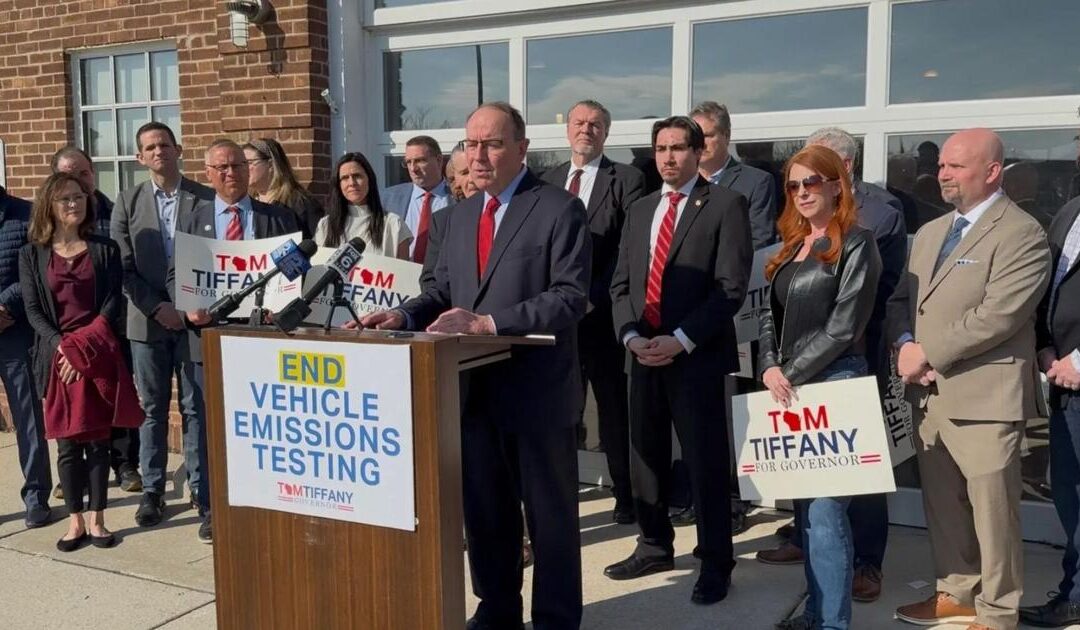
(The Center Square) – Tom Tiffany remains the clear favorite to be the Republican nominee for Wisconsin governor with 40% support compared to just 6% for Andy Manske, while Francesca Hong has the most support with 14% in a Democratic primary where 65% of voters say that they remain undecided.
The University of Marquette Law School poll asked 850 registered voters about their preferences from March 11-18. The gubernatorial primary is set for August. 11 with the general election on Nov. 3.
Hong, a state representative from Madison, is ahead of former Lt. Gov. Mandela Barnes (11%), Milwaukee County Executive David Crowley (3%), Lt. Gov. Sara Rodriguez (3%), businessman Joel Brennan (2%), state Rep. Kelda Roys (1%) and former Wisconsin Economic Development Corp. CEO Missy Hughes (1%).
“Most of these Democratic candidates are very little known right now,” said Charles Franklin, director of the Marquette Law School Poll.
Barnes had the most name recognition with only 44% saying they haven’t heard enough about him while Rodriguez was at 68%, Hong at 72%, Crowley at 76% and the rest had more than 80% of respondents saying that they did not know enough.

Poll: Taylor’s lead in Wisconsin Supreme Court race over Lazar widens

Poll: Taylor’s lead in Wisconsin Supreme Court race over Lazar widens

(The Center Square) – Judge Chris Taylor, a former Democratic state representative, widened her margin of lead over conservative Maria Lazar with 23% of voters compared to Lazar’s 17% with two weeks remaining before the state’s April 7 Wisconsin Supreme Court election, though 53% of the voters say they remain undecided.
The University of Marquette Law School poll asked 850 registered voters about their preferences from March 11-18.
“People were much more aware of the court race last year than this year,” said Charles Franklin, director of the Marquette Law School Poll.
The court currently has four liberal members and three conservative justices and this election is to fill the seat of conservative Rebecca Bradley. Conservative Annette Ziegler has announced that she will not run again in 2027.
“There’s obviously a lot of room for change in these last two weeks,” Franklin said. “We don’t usually have this many people undecided this close to an election.”
Franklin said that Taylor has an even larger advantage over Lazar amongst registered voters who said they were likely to vote in the race with 30% supporting Taylor and 22% supporting Lazar.

Brewers Beer District ‘probably a long time planning’

Brewers Beer District ‘probably a long time planning’

(The Center Square) – As the Milwaukee Brewers get ready to start a new season, the future of a new ballpark addition remains up in the air.
Brewers President of Baseball Operations Rick Schlesinger on Tuesday said they are likely a long way away from even making a decision on a so-called beer district.
“That’s probably a long-time planning,” Schlesinger said during an interview on News Talk 1130 WISN. “We’ve had a number of discussions with potential developers. The conditions to do it have to make sense, both economically and we have to do something that works with the neighborhood…I wouldn’t say anything is imminent, but we’re doing a lot of research and analysis.”
The possible district would be loosely modeled after the Milwaukee Bucks’ Deer District. Plans could include a hotel, bars, restaurants, and even office and apartment space.
Schlesinger said in addition to being mindful of American Family Field’s neighbors, he also wants to be mindful of Brewer fans and their tailgating tradition.
“We do have a tailgating culture, and we also love the convenience for fans of having so many parking spaces,” Schlesinger added.
But he also said American Family Field is not in the city’s center, like Wrigley Field in Chicago or Busch Stadium in St. Louis.
“We don’t have a lot of people who can walk to the ballpark,” he said. “So, we need to make sure that we are accommodating fans who come to the ballpark for games, as well as figure out a way to figure out a way for commercial, residential, and industrial real estate development that makes sense for the neighborhood.”
The Brewers are required to study a beer district as part of the 2023 state law that guaranteed American Family Field’s owner, the Wisconsin Professional Baseball Park District, nearly $379 million in state money.
An early draft of that study suggests it could cost as much as $821 million to build the new district.
The Brewers are opening a new patio area at the ballpark this year, but it will be built along an empty walkway just outside of Am Fam Field.
Schlesinger said that patio will open a temporary space later this summer and be fully open sometime next year.

Kinser: School board elections are too important to ignore

Kinser: School board elections are too important to ignore

(The Center Square) – As voters get ready to cast their votes in Wisconsin’s April election, there is a reminder about just what’s on the ballot.
Brittany Kinser, who ran for Wisconsin State Superintendent last year, has a new op-ed that explains how important local school board elections are.
“School board members and school board candidates are the largest elected official body in our entire country,” Kinser said during an interview Monday on News Talk 1130 WISN. “And they are the ones deciding so many important things for our schools.”
Kinser said the main job of a school board is to make sure that students are reading, writing, and doing math proficiently.
But in Wisconsin, most school students are not.
“Only one in three kids in Wisconsin are,” Kinser explained. “That means two out of three kids are not [reading proficiently.]”
Kinser said one of the biggest challenges for voters is that many voters don’t know who the candidates are or what those candidates want for local schools. But she suggested some questions voters could ask.
“I would ask, especially coming from Kids Win, where we’re focusing on literacy, ‘Do you know the current third grade literacy rate in our district?’” Kinser said. “Then I would ask ‘What systems will you put in place to monitor progress, celebrate growth, and move us towards 95% of students reading proficiently?’ So right there they’re going to be able to tell you whether or not they’re aware of academic results, are they focused on the kids, and then what are they going to do.”
Kinser’s website, KidsWin.org has reading proficiency scores for every school district in the state.
She also said parents should look into the science of reading and ask if their school board candidates are familiar with it.
Early voting for Wisconsin’s spring election begins Tuesday. Election Day is April 7.

Evers signs Wisconsin FoodShare bill with $72M in funding, candy and soda ban

Evers signs Wisconsin FoodShare bill with $72M in funding, candy and soda ban

(The Center Square) – Wisconsin Gov. Tony Evers signed a bill Monday that would send $72 million to the state’s FoodShare program along with banning candy and soda purchases in Wisconsin’s Supplemental Nutrition Assistance Program.
The bill was a compromise between Evers and Republican legislative leaders as Evers claimed that the state was at risk of going over a 6% error rate on SNAP Program benefits, which would incur more than $200 million in federal penalties. Wisconsin had a 4.47% payment error rate as of late 2024–2025.
“After months of urging and asking the Legislature to approve these funds, I am glad to be able to sign this bill today so we can continue to provide for the over 700,000 Wisconsinites who rely on FoodShare and depend on the state to support this critical program and keep our error rates low,” Evers said in a statement. “In spite of the chaos at the federal level and the continued attacks on our FoodShare program, I am proud of the work my administration has done over the past year to ensure our kids, families, veterans, and seniors across our state receive the resources they need to access basic food and groceries.”
Legislative leaders like Sen. Chris Kapenga, R-Delafield, questioned whether the state was actually at risk of going over 6% on its error rate.
“We have asked him to show us the data and he hasn’t,” Kapenga told Badger Institute. “But that’s the way he has always operated.”
The Assembly passed the latest version of the bill, 71-22, while the Senate passed the bill 25-8.

Wisconsin makes fraudulent claims for unclaimed funds a felony

Wisconsin makes fraudulent claims for unclaimed funds a felony

(The Center Square) – It is now a felony to intentionally file a claim for someone else’s unclaimed property in Wisconsin without consent after Gov. Tony Evers signed the bill into law.
The Department of Administration estimates that there will be 12 fraudulent claims each year with a value of $260,000 that could be impacted by the new law with local district attorneys expected to prosecute the cases using existing resources.
“By finally holding these fraudsters accountable, we will be able to better protect our residents from being swindled out of their hard-earned money,” bill sponsor Sen. Patrick Testin, R-Stevens Point, wrote on social media on Monday.
I am pleased the governor has signed into law my bill that focuses on preventing fraudulent activity within the Wisconsin Unclaimed Property system. Since 1970, the state has been statutorily required to hold on to abandoned or forgotten financial assets until they can be… pic.twitter.com/05cFJck3ZC— Sen. Patrick Testin (@SenatorTestin) March 23, 2026
Rep. Jerry O’Connor, R-Fond Du Lac, testified that the unclaimed property inventory is now $866.8 million with 48,763 claims totaling $44.1 million processed and approved to return to property owners in fiscal year 2025.
He said that 126 fraudulent claims worth $2.6 million were denied due to fraud in 2025 and a claim worth $800,000 fraudulent claim to a Georgia recipient was blocked when a bank in Georgia flagged the check.
“Unclaimed property is an easy target for fraudsters, as Wisconsinites are frequently unaware that they have it, and doctoring documents is only getting easier with Artificial Intelligence,” O’Connor testified.

Oconto Falls sexual misconduct accusers propose student rights legislation

Oconto Falls sexual misconduct accusers propose student rights legislation

(The Center Square) – A group of plaintiffs in a federal civil rights lawsuit against the Oconto Falls School District over sexual misconduct from staff are proposing that state lawmakers create a Student Bill of Rights related to handling sexual misconduct from staff.
The legislation would do everything from requiring prompt investigations of complaints and protecting victims from retaliation to blocking school employees from engaging in romantic or sexual relationships with former students until they turn 24.
“Enforcement mechanisms include a private right of action for harmed students, Department of Public Instruction oversight, potential loss of state funding for non-compliant districts and mandatory annual public reporting of misconduct statistics,” the proposed legislation reads.
The proposal comes from victims through the Disparti Law Group, which said that six additional students and two former teachers have come forward since the lawsuit was initially filed with more details claiming the school district did not respond appropriately to complaints.
Disparti Attorney Cass Casper said that the two former teachers provided sworn declarations that they reported teacher sexual abuse and sexual harassment directly to the school board in 2015 and, not only do they say the board did not take them seriously, they claim the man was then promoted while one of the accusers left the district and the other had her contract not renewed.
Casper said the new accusations “add to this picture of a school district that had created an environment where sexual abuse is allowed to flourish and nothing was being done to prevent it.”
The proposed legislation would need legislative sponsors in order to be introduced in the next session.
The eight proposed students rights include a right to a safe learning environment, prompt investigation of misconduct reports, protection from retaliation and removal from contact with accused employees.
It also includes mandatory obligations for school boards, including beginning an investigation within five business days of a report, reporting accused employees to licensing authorities and maintaining confidential student reporting systems as well as annual training for staff to recognize grooming behavior.

Evers vetoes UW free speech, aid, online course fee bills

Evers vetoes UW free speech, aid, online course fee bills

(The Center Square) – Wisconsin Gov. Tony Evers vetoed a set of three University of Wisconsin-related bills Friday that included free speech protections on campus, a block of additional online course fees and a bill that would change minority programs to programs for disadvantaged students.
Senate Bill 532 would prevent University of Wisconsin schools from assessing the online class fees unless the school can show actual additional costs to conduct the classes online.
Bill sponsors say that fees for online-only or hybrid courses can add up and be a hidden way for the university to add cost to college.
Evers called the bill an attempt to undermine the Board of Regents.
“If lawmakers sincerely cared about the soaring costs of higher education for students on Wisconsin campuses, they would have approved any number of the countless measures and investments I have proposed over my tenure to ensure the University of Wisconsin System can survive and thrive without having to frequently rely on raising tuition or increasing various fees for students and families,” Evers wrote. “Moreover, this legislation risks reducing the availability of online course opportunities that students rely on for a flexible and accessible education.”
The campus free speech bill would carry a punishment of two academic years of frozen tuition if a school violates any of the requirements of the bill multiple times in a five-year period.
“Having personally served on the Board of Regents as State Superintendent of Public Instruction and having visited most if not all University of Wisconsin System and Wisconsin Technical Colleges System campuses, respectively, during my time as governor, I am happy to report to members of the Wisconsin State Legislature that the First Amendment and freedom of speech remain alive, well, and thriving on Wisconsin college campuses,” Evers wrote.
The third veto came on a bill that would have changed minority student aid programs to programs that provide aid to disadvantaged students of all races.
“I am vetoing this bill in its entirety because I object to the Wisconsin State Legislature creating new censorship rules that are designed to police language on our higher education campuses and ultimately prevent our state’s higher education institutions from acknowledging students come to our college campuses with unique and diverse backgrounds, experiences, and needs,” Evers wrote.

Evers vetoes Wisconsin Red Tape Reset bills

Evers vetoes Wisconsin Red Tape Reset bills

(The Center Square) – Wisconsin Gov. Tony Evers vetoed a set of four bills dubbed the red tape reset on Friday that would have cut down on the 165,000 restrictions currently in state law.
The set of bills include regulatory sunsetting, regulatory budgeting, a one rule per scope statement and a proposal challenging the validity of administrative rules.
Evers said that he vetoed the bills because he feels like it is an attempt by the Legislature to encroach on administrative rulemaking.
“Further, I also object to the Legislature making state government less efficient, less effective, and less responsive to the people of Wisconsin,” Evers wrote. “Ironically, for a Legislature fraught over purportedconcerns of inefficiency, regulations, and any “growth” of government, the Legislature asks me to sign a bill that will do just that.”
The laws would have required that, when a new rule adds costs for businesses, families or local governments, those costs must be offset.
“People are struggling with rising costs. Instead of providing relief, the Governor chose to protect bureaucracy,” Sen. Julian Bradley, R-New Berlin, said about the vetoes. “The Red Tape Reset was about making it easier to build a home, start a business, or simply get ahead. Today, the Governor chose to stand in the way of that progress.”
The single scope bill blocks allowing agencies to use a single scope statement to create multiple regulations over time.
The challenge bill would require courts to award attorney fees and costs to plaintiffs who successfully challenge unlawful administrative rules.
“This veto is telling of the Democrat approach,” Bradley said. “We can protect public safety and our state without burying Wisconsinites under layers of unnecessary red tape. I remain committed to working with my colleagues to bring accountability to our unelected bureaucrats.”

Wisconsin tax collection were down year-over-year in February

Wisconsin tax collection were down year-over-year in February

(The Center Square) – Wisconsin collected 8.8% less in taxes and fees in February than it did the year before, a $90 million drop in general purpose revenue.
The state is still 4.5% ahead of what it collected last fiscal year through February, according to numbers released Friday by the Department of Revenue.
The largest drop was in individual income taxes, a 30.3% drop from the year before, representing $122 million of the drop. The state is 4.8% above the year before in adjusted income tax collections for the fiscal year.
Overall, Wisconsin has collected $13.5 billion of general purpose revenue through February compared to $12.9 billion the year before.
Wisconsin is expected to have $2.3 billion more than estimated in surplus at the end of its current two-year budget cycle. That was due to an estimated nearly $1.4 billion in increased tax collections over that span.