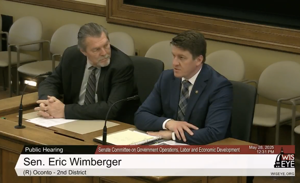
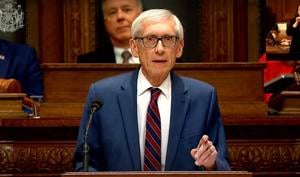
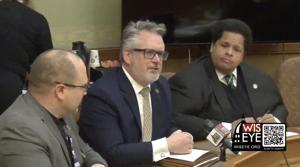
(The Center Square) – Despite Republican Assembly leaders and Wisconsin Gov. Tony Evers having reached a budget deal to appropriate the interest earnings from unspent COVID-19 relief funds toward budget initiatives, Sen. Eric Wimberger, R-Oconto, claims there is still $4 million unaccounted for.
The current 2025-27 Wisconsin biennial budget, signed into law by Evers early Thursday morning, accounts for only $171 million of the interest earnings, which Wimberger said has now ballooned up to $175 million.
While $170 million will fund key budget initiatives, with most of it dedicated to child care, the remaining $4 million will continue to accrue interest if left in Evers’ Department of Administration.
In other words, the budget deal, which Wimberger previously said “probably solves a potential constitutional crisis,” has not securely ended the months-long fight over the governor’s “slush fund.”
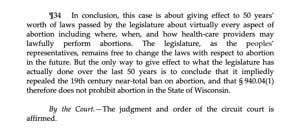
“State law makes it clear that the $175 million slush fund accrued by Governor Evers was illegal,” Wimberger said in a statement to The Center Square. “The legislature must be the body to appropriate these funds, and the Governor concedes this point in the budget agreement.”
As co-chair of the Audit Committee, Wimberger said he would continue to monitor the amount of interest accrued until all the federal COVID-19 relief money is spent.
Additionally, his office affirmed that he will continue to advance the legislation co-authored with Rep. Robert Wittke, R-Caledonia, to ensure that CSLFRF interest money left unspent gets transferred into the treasury.
In the budget, $115 million of the interest earnings went to fund child care initiatives, while another $50 million went to support a building commission grant program.
Also, $5 million goes to a food security grant program and another $1 million goes to a UW-Green Bay high school college credit program.
Joint Finance Committee co-chair Rep. Mark Born, R-Beaver Dam, previously said in an interview with The Center Square that negotiating with Evers to put the money towards actual budget initiatives was better than leaving it up to Evers’ discretion or a court fight.
“In our discussions with the governor, we continued to find ways to make investments – preferably one-time investments – to get the money used for something so it didn’t just become a slush fund that he was just gonna try to control,” Born said.
The budget appropriations, in total, leave $171 million accounted for of the $175 million, the majority of which went to Evers’ highest child care priorities.
However, a growing $4 million in interest earnings remains with the DOA.
According to federal law, all CSLFRF funds most be expended by December 31, 2026.
That gives Evers until then to hand over or expend the remaining $4 million.
Additionally, Wimberger criticized Evers’ decision to veto four new auditors for the Legislative Audit Bureau from the budget, saying it underscores his “bad policies.”
“As Audit Committee co-chair, we’ve been able to uncover a $175 million slush fund, administrative bloat at the UW System, discriminatory DEI policies across state government, and major dysfunction at the Department of Public Instruction,” Wimberger said in a statement. “Vetoing funding for new auditors is simply the Governor’s attempt to stifle good government oversight of his bad policies.”
However, Evers stated his only reason for having vetoed the positions was that “the Legislative Audit Bureau currently has sufficient funding and position authority to fulfill its role,” according to the governor’s veto message.
Evers’ office did not immediately respond to an email seeking comment at the time of publication.